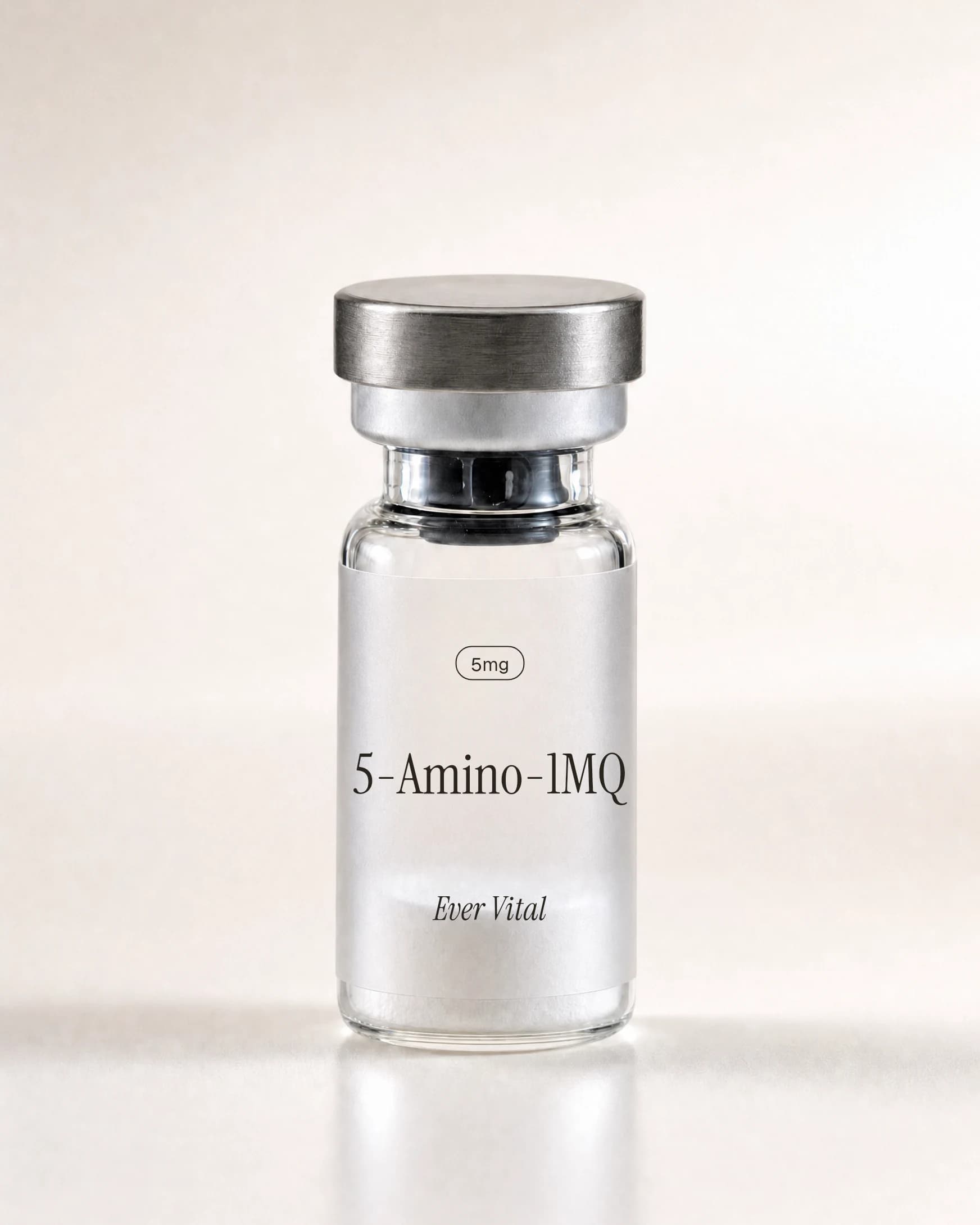
5-Amino-1MQ is a small-molecule research compound studied as a selective inhibitor of nicotinamide N-methyltransferase (NNMT), an enzyme positioned at the intersection of cellular methylation metabolism and NAD+ precursor handling. Unlike most compounds in the Ever Vital catalog, it is not a peptide — it carries no amino acid sequence and is instead a substituted quinolinium compound. It is catalogued under CAS number 42464-96-0, with a free-base molecular weight of 159.21 g/mol and the molecular formula C10H11N2 (free base). Ever Vital supplies 5-Amino-1MQ as a lyophilized research-grade powder at 99%+ purity by HPLC, intended solely for laboratory research and not for human use. Its research relevance to Ever Vital's cellular aging and redox lane comes from its mechanistic position: NNMT consumes the same methyl-donor and NAD+ precursor pools that are central to research on cellular energy metabolism and aging biology.
What is the molecular structure of 5-Amino-1MQ?
5-Amino-1MQ (5-amino-1-methylquinolinium) is built on a quinolinium core — a bicyclic aromatic ring system carrying a permanently charged quaternary nitrogen — substituted with an amino group at the 5-position and a methyl group at the ring nitrogen (position 1). The free-base form has a molecular weight of 159.21 g/mol and the formula C10H11N2. This quinolinium scaffold is the structural feature that published biochemical characterizations identify as central to the compound's binding behavior at the NNMT active site: the positively charged ring nitrogen is positioned to engage the same binding pocket that normally accommodates the enzyme's substrate, nicotinamide, and its methyl-donor cofactor. Research-grade material is synthesized and purified to a specification of 99%+ by HPLC, supplied as a lyophilized powder, and stored at −20°C.
What is NNMT and why is it a research target?
Nicotinamide N-methyltransferase catalyzes the transfer of a methyl group from S-adenosylmethionine (SAM) to nicotinamide, producing 1-methylnicotinamide (MNA) and S-adenosylhomocysteine (SAH) as products. This single reaction places NNMT at a metabolic crossroads: nicotinamide is also the substrate for NAD+ salvage synthesis via nicotinamide phosphoribosyltransferase (NAMPT), and SAM is the universal methyl donor used across hundreds of cellular methylation reactions, including histone and DNA methylation. Because both substrates are shared with other central metabolic pathways, NNMT is described in the published literature as a competitive branch point — when NNMT activity is high, less nicotinamide is available for the NAD+ salvage pathway, and less SAM is available for other methyltransferase reactions.
Published expression studies have characterized NNMT as highly expressed in adipose tissue and liver relative to most other tissue types, with additional research describing altered NNMT expression levels in a range of cell models relevant to metabolic and aging research, including cultured hepatocytes and differentiated adipocytes. Genetic knockdown studies in cultured cells have been used to establish the directionality of NNMT's effect on the metabolites it consumes and produces, providing the mechanistic basis that later motivated development of small-molecule NNMT inhibitors such as 5-Amino-1MQ as pharmacological research tools. Because NNMT activity draws directly from both the NAD+ precursor pool and the cellular SAM pool, it has become a research target for investigators studying how methyl-group availability and NAD+ metabolism interact at the cellular level — a question central to the broader cellular aging and redox literature that Ever Vital's catalog serves.
What does published research describe about 5-Amino-1MQ's NNMT inhibition mechanism?
Published biochemical and structural characterization work describes 5-Amino-1MQ as a selective, cell-permeable small-molecule inhibitor of NNMT, distinguishing it from earlier NNMT-directed tool compounds that suffered from poor cell permeability or off-target activity against related methyltransferases. Enzyme kinetics studies have characterized 5-Amino-1MQ's inhibition as competitive with respect to the nicotinamide substrate, consistent with the compound's quinolinium ring occupying the nicotinamide-binding subsite of the NNMT active site. Cell-based research has used 5-Amino-1MQ to characterize downstream changes in intracellular MNA production and SAM/SAH ratios following NNMT inhibition, using these as pharmacodynamic readouts of target engagement in cultured cell systems. This mechanistic characterization work — establishing selectivity, binding mode, and cellular target engagement — is the foundation for the compound's use as a research tool in the broader NNMT literature.
How is 5-Amino-1MQ studied in cellular NAD+ and methylation metabolism research?
Because NNMT competes with NAD+ salvage synthesis for the shared nicotinamide substrate pool, research using 5-Amino-1MQ has examined whether NNMT inhibition shifts the balance of nicotinamide utilization toward NAD+ regeneration in cell models. Published cell culture studies have measured intracellular NAD+ and NADH levels following 5-Amino-1MQ treatment, framing the compound as a tool for probing the relationship between NNMT flux and cellular NAD+ status — a research question that connects directly to the broader NAD+ metabolism literature that also includes direct NAD+ precursor supplementation research. A parallel line of published work has examined the SAM/SAH ratio, sometimes referred to as the cellular methylation index, in cell models treated with 5-Amino-1MQ, characterizing changes in global and gene-specific methylation marks as a downstream consequence of altered methyl-donor availability. Researchers working across this metabolic axis at Ever Vital also have access to NAD+ itself as a direct precursor-pathway research compound, allowing comparative study designs that examine NAD+ pool regulation from both the salvage-synthesis side and the NNMT-competition side.
What has research examined about 5-Amino-1MQ in adipocyte and cellular senescence models?
NNMT expression has been characterized as particularly high in adipose tissue, and published research using 5-Amino-1MQ in cultured adipocyte models has examined markers of adipocyte energy metabolism, including mitochondrial oxidative gene expression, uncoupling protein expression, and cellular lipid handling markers, in the context of NNMT pathway inhibition. These studies are framed at the level of gene expression and cellular metabolic marker characterization — describing what the pathway does in a differentiated adipocyte cell model, not what the compound does for an organism or a person. Separately, and more directly relevant to Ever Vital's cellular aging research lane, published work has characterized NNMT as a gene with altered expression in models of cellular senescence, motivating research into whether NNMT activity and the resulting shifts in NAD+ and SAM availability contribute to the metabolic phenotype associated with senescent cells. Cell-based studies in this area use 5-Amino-1MQ as a pharmacological tool to isolate the contribution of NNMT enzymatic activity from other senescence-associated changes, providing a way to test NNMT-specific hypotheses within the broader cellular aging research framework. Ever Vital makes no claims regarding outcomes from 5-Amino-1MQ; the compound is studied strictly for its effects on these metabolic and methylation pathway markers in cell-based research models.
How does 5-Amino-1MQ relate to other NAD+ and redox research compounds in the catalog?
Because 5-Amino-1MQ acts upstream of NAD+ status by modulating nicotinamide availability rather than by supplying NAD+ directly, research designs frequently pair it with compounds that act on the NAD+ pool through other mechanisms. Direct precursor supplementation, using NAD+ itself in cell culture media, addresses the salvage pathway from the substrate-supply side, while 5-Amino-1MQ addresses it from the competing-consumption side by reducing the fraction of nicotinamide diverted to the NNMT reaction. A third mechanistic angle in the same broader research space is cellular redox buffering, where compounds such as Ever Vital's glutathione are studied for their role in the thiol-based antioxidant system rather than the NAD+/methylation axis. Researchers designing multi-arm cell-model studies across mitochondrial energetics, NAD+ metabolism, and redox buffering use these three mechanistically distinct compounds to isolate which axis is driving a given phenotype in aged or stressed cell models — a study design consideration that is specific to the cellular aging research field rather than to synthetic-peptide pharmacology generally.
How should 5-Amino-1MQ be handled for research use?
5-Amino-1MQ is supplied as a lyophilized powder and stored at −20°C to preserve compound stability. As a small aromatic quinolinium compound, its primary handling considerations differ from those of peptide compounds: it is not subject to peptide bond hydrolysis, but researchers characterizing long-term stability should account for potential photosensitivity of the aromatic ring system and hygroscopic behavior common to quaternary ammonium salts. Research handling practices that support experimental reproducibility include maintaining cold, dry storage conditions and verifying compound identity against the expected molecular weight using the batch-specific Certificate of Analysis. This article does not provide preparation or solution-making protocols; those procedures are determined by the investigator according to experimental requirements and applicable laboratory guidelines. For guidance verifying batch-level analytical documentation, see the Ever Vital guide on verifying third-party testing claims.
How does Ever Vital source 5-Amino-1MQ?
Ever Vital supplies 5-Amino-1MQ as a research-grade compound held to a purity specification of 99%+ by HPLC, with mass spectrometry identity confirmation and a batch-specific Certificate of Analysis documented for every batch. Researchers can review specifications, available sizes, and pricing on the 5-Amino-1MQ product page, or browse the complete research catalog at all compounds. For related cellular aging and redox metabolism research compounds, see the Ever Vital overview of longevity research peptide categories. All material is intended for laboratory research use only.
This compound is a research chemical intended for laboratory and scientific research purposes only. It is not a drug, supplement, or food, and is not intended to diagnose, treat, cure, or prevent any disease. Ever Vital does not sell products intended for human use. Researchers are responsible for compliance with all applicable local, state, and federal regulations.
Join the list.
Restock alerts, subscriber discounts, and first access to new compound drops.