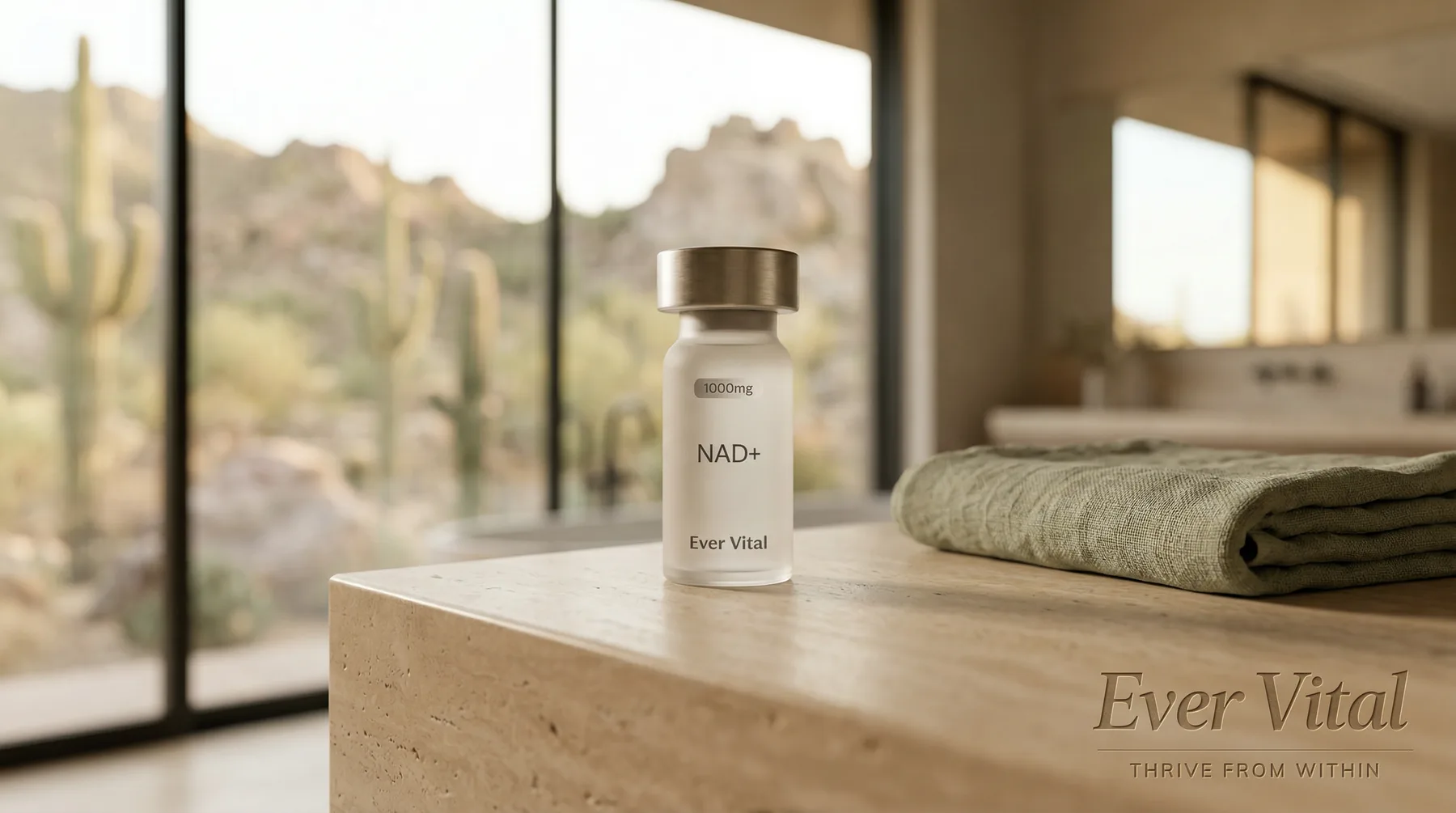
NAD+ (nicotinamide adenine dinucleotide, oxidized form) is a pyridine dinucleotide coenzyme present in all living cells and essential to a broad range of enzymatic reactions. It is catalogued under CAS number 53-84-9 with a molecular formula of C₂₁H₂₇N₇O₁₄P₂ and a molecular weight of 663.43 g/mol (anhydrous free acid). In research settings, NAD+ is studied for its central role in the cellular redox system, its function as an obligate substrate for several classes of regulatory enzymes including sirtuins and poly-ADP ribose polymerases (PARPs), and its involvement in signaling through cyclic ADP-ribose pathways. The compound is supplied as a lyophilized powder for laboratory research and is intended solely for research purposes, not for human use. Ever Vital's catalog offers NAD+ at a purity of 99%+ by HPLC, available in 500mg and 1000mg sizes.
What is the molecular structure of NAD+?
NAD+ is composed of two nucleotide subunits joined by a pyrophosphate bridge: adenosine monophosphate (AMP) and nicotinamide mononucleotide (NMN). The nicotinamide ring — derived from niacin (vitamin B3) — is the chemically reactive portion of the molecule. In the oxidized NAD+ form, the nicotinamide ring carries a positive charge at the nitrogen, which accounts for the "+" in the name. The molecular formula C₂₁H₂₇N₇O₁₄P₂ reflects the adenine ring, ribose sugars, nicotinamide ring, and bridging phosphate groups. The molecular weight of 663.43 g/mol applies to the anhydrous free acid form. Hydrated forms have slightly higher molecular weights depending on water of crystallization. As with other dinucleotides, structural integrity is sensitive to acidic conditions, elevated temperatures, and prolonged solution-phase storage, which is why the lyophilized form is stored at −20°C for research applications.
What role does NAD+ play as a coenzyme in cellular redox reactions?
The primary biochemical function of NAD+ is to act as an electron acceptor in oxidation-reduction reactions. The NAD+/NADH couple operates as a redox shuttle: NAD+ accepts a hydride ion (H⁻) from a metabolic substrate, becoming reduced to NADH, and NADH subsequently donates those electrons to the electron transport chain to regenerate NAD+ and drive ATP synthesis. This cycle is fundamental to glycolysis, the citric acid cycle, and mitochondrial oxidative phosphorylation. Published research uses the NAD+/NADH ratio as a measurable proxy for cellular metabolic state and mitochondrial function in cell culture and tissue models. Because the ratio reflects the balance between NAD+-consuming and NADH-regenerating reactions, it is a standard readout in assays studying metabolic pathway flux and bioenergetic status. These studies frame NAD+ involvement as a mechanistic research tool — not as a proxy for clinical outcomes.
How is NAD+ studied in relation to sirtuin enzymes?
Sirtuins (SIRT1–7 in mammals) are NAD+-dependent protein deacetylases and ADP-ribosyltransferases that regulate chromatin structure, transcription factor activity, DNA damage response, and mitochondrial biogenesis through post-translational modification of target proteins. Their catalytic cycle consumes NAD+ as an obligate cofactor: each deacetylation reaction cleaves one molecule of NAD+ into nicotinamide and O-acetyl-ADP-ribose, in addition to releasing the deacetylated lysine residue. This dependency makes cellular NAD+ availability a direct variable in sirtuin enzymatic activity in research models. Published research examining sirtuin function in cell culture therefore frequently manipulates NAD+ levels or supplementation — using NAD+ as a substrate to characterize concentration-response relationships in sirtuin activity assays. Researchers studying the sirtuin family's regulatory roles in gene expression, metabolism, and cellular stress signaling use Ever Vital's NAD+ at 99%+ purity to establish reproducible in vitro conditions.
What is the relationship between NAD+ and PARP enzymes in DNA damage research?
Poly-ADP ribose polymerases (PARPs) are a family of enzymes that catalyze the post-translational addition of ADP-ribose polymers to target proteins using NAD+ as the substrate. PARP-1, the best-characterized member, is rapidly activated at sites of DNA strand breaks and uses NAD+ to synthesize chains of poly-ADP-ribose on histones and other nuclear proteins, creating a scaffold that recruits DNA repair machinery. Each cycle of poly-ADP-ribosylation consumes NAD+ stoichiometrically — high levels of PARP-1 activation can substantially deplete local and cellular NAD+ pools in cell models. This link between DNA damage signaling and NAD+ consumption is studied in the context of the DNA damage response and genomic maintenance pathways. Published research uses isolated PARP-1 activity assays with NAD+ as a defined substrate to characterize inhibitor concentration-response relationships and to measure repair pathway activity under various conditions.
What does published research describe about NAD+ and CD38 signaling?
CD38 is a multifunctional ectoenzyme expressed on immune cells and other cell types that has two primary enzymatic activities relevant to NAD+ biology: it hydrolyzes NAD+ to produce cyclic ADP-ribose (cADPR) and ADP-ribose, and it converts NADP+ to cyclic ADPR phosphate. These products function as intracellular messengers that mobilize calcium from the endoplasmic reticulum. Published research characterizes CD38 as a major consumer of NAD+ in cellular systems — CD38-mediated hydrolysis represents a significant pathway through which cellular NAD+ is turned over outside of the electron transport chain and sirtuin cycles. Research studying calcium signaling dynamics in lymphocytes and cardiac cells frequently examines CD38 enzymatic activity with NAD+ as the defined substrate. CD38's role as an NAD+ consumer has drawn interest in the aging biology field, where its expression and activity have been studied in cell-level models of NAD+ flux alongside sirtuin and PARP pathway activity.
How does NAD+ compare structurally to NMN and NR?
NAD+ research is closely related to work on nicotinamide mononucleotide (NMN) and nicotinamide riboside (NR), two NAD+ precursor molecules that are studied because cells can convert them into NAD+ through the NAD+ salvage pathway. NMN (MW ~334 g/mol) is a single nucleotide representing the nicotinamide mononucleotide half of the NAD+ dinucleotide. NR (MW ~255 g/mol) is the nucleoside form — nicotinamide attached to ribose — that is phosphorylated to NMN before incorporation into NAD+. Research using NAD+ directly differs from research using precursors because it bypasses the biosynthetic steps and delivers the coenzyme as a defined substrate. Investigators choosing between NAD+ and its precursors in research design should consider which enzymatic steps are under study: if the goal is to characterize the salvage pathway itself, precursor use is relevant; if the goal is to examine NAD+-dependent enzyme kinetics directly, the dinucleotide is the appropriate substrate.
What does published research describe about NAD+ in cellular aging models?
Research examining NAD+ in the context of cellular aging is conducted in cell culture systems and preclinical models. Published studies report that NAD+ availability influences the activity of sirtuin deacetylases and PARP enzymes in aged versus young cell culture models, and that this availability shifts measurably across conditions studied in vitro. The research frame is mechanistic: investigators examine how NAD+ concentration affects enzymatic activity, transcriptional regulation, and metabolic pathway flux in defined model systems, not in human subjects. Ever Vital makes no claims that NAD+ supplementation produces any therapeutic or anti-aging effect. The compound is studied as a biochemical research tool to characterize the enzymology of NAD+-dependent pathways and to establish the role of coenzyme availability in cellular metabolic regulation. For the broader redox biology research context, including glutathione and thioredoxin system research, see the longevity research compound categories overview.
How should NAD+ be handled and stored for research use?
NAD+ is supplied as a lyophilized powder and is stored at −20°C to preserve chemical integrity. The compound is sensitive to acidic hydrolysis, alkaline conditions, elevated temperatures, and prolonged storage in aqueous solution. Nicotinamide release from the dinucleotide under acidic conditions is the primary degradation pathway and generates a compound that can confound enzymatic assays if present at significant concentrations. Research handling practices that support reproducibility include maintaining cold storage, protecting from light, minimizing freeze-thaw cycles for any prepared solutions, and verifying preparation freshness before use in enzymatic assays. For longer-term research programs, aliquoting the lyophilized stock and storing under inert atmosphere reduces oxidative degradation. This article does not provide preparation or solution-making instructions; these protocols are determined by the investigator according to experimental requirements and applicable laboratory procedures.
How does Ever Vital source NAD+?
Ever Vital supplies NAD+ as a research-grade compound at 99%+ purity by HPLC, with mass spectrometry identity confirmation on every batch. Available in 500mg ($100) and 1000mg ($120) sizes, it is among the higher-volume metabolic substrates in the Ever Vital catalog — reflecting the frequency with which NAD+ is consumed as a reagent in enzymatic assay work. Each batch is documented with a Certificate of Analysis as standard. For guidance on verifying that documentation, see the Ever Vital guide on verifying third-party testing claims. Researchers can review specifications, sizes, and pricing on the NAD+ product page, or browse the complete research catalog at all compounds. All material is intended for laboratory research use only and is not for human use.
This compound is a research chemical intended for laboratory and scientific research purposes only. It is not a drug, supplement, or food, and is not intended to diagnose, treat, cure, or prevent any disease. Ever Vital does not sell products intended for human use. Researchers are responsible for compliance with all applicable local, state, and federal regulations.
Join the list.
Restock alerts, subscriber discounts, and first access to new compound drops.